
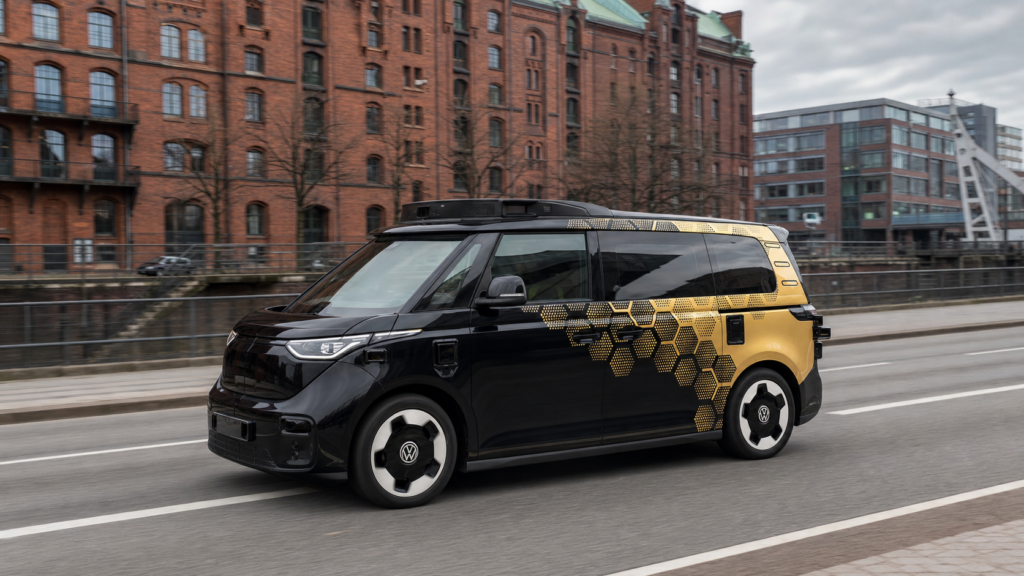
Residents of Hamburg can now open an app and summon a ride in a van with nobody steering it. Volkswagen’s mobility unit Moia has started shuttling preregistered passengers around the German city in autonomous ID. Buzz vans, a milestone that puts a major European automaker into the self-driving passenger business on its own home turf.
- Moia is running up to five self-driving ID. Buzz vans in Hamburg, with plans to grow the fleet to ten.
- Rides are free during the pilot and booked through the Moia app, with a trained safety monitor riding along.
- The project is government-backed and aims for fully driverless approval in Europe by 2027.
A New Kind of Ride Appears on City Streets
The service works more like a smart shuttle than a private robotaxi. Riders heading in similar directions can end up sharing a van, and instead of true door-to-door pickup, passengers walk to designated virtual stops scattered around the coverage area. That area currently spans about four square miles of Hamburg, with plans to grow it to roughly 14 square miles as the pilot matures. Moia says several thousand people had already joined the waiting list once registration opened, a sign that curiosity about driverless transport runs high even among everyday commuters.
How the Pilot Actually Works
Every van still carries a trained safety monitor who can step in if needed, even though the vehicles operate at SAE Level 4 autonomy, meaning the system handles driving tasks on its own within its mapped zone. The underlying self-driving technology comes from Mobileye, a company with years of experience in advanced driver assistance and autonomous systems. Passengers ride free for now, and the pooled format means the vans function less like a taxi replacement and more like a flexible extension of public transit. Moia has said it eventually wants to link the service directly with Hamburg’s hvv switch transit app, so booking an autonomous shuttle feels as routine as catching a bus or train.
The idea of vans handling group transportation is not new. Companies have long adapted passenger vans for everything from airport runs to a Mercedes Sprinter van limo booked for a night out on the town, so it makes sense that automakers see vans as a natural shape for shared autonomous mobility too.
Government Backing and Wider Ambitions
The Hamburg rollout sits inside a program called ALIKE, funded by Germany’s Federal Ministry for Digital and Transport through mid-2027. That kind of public backing gives Moia room to test and refine the system before seeking full driverless approval, which the company is targeting for 2027 in Europe. Moia has also been clear that it does not want to run a standalone robotaxi brand the way some competitors do. Instead, the plan is to offer a ready-made autonomous mobility platform that public agencies and private fleet operators can plug into, a somewhat different strategy than the private ride-hailing model most rivals are chasing. MOIA’s autonomous-mobility program frames that approach around city-focused, on-demand transportation.
Volkswagen is not stopping at Germany, either. Moia is preparing to launch an autonomous shuttle service in Orlando with partner Beep, targeting a fleet that could eventually grow to as many as 5,000 vehicles over the next decade. In Los Angeles, autonomous ID. Buzz vans are being tested for deployment on the Uber platform, with on-road testing already underway using around ten vehicles.
Hamburg’s Pilot Sets Up What Comes Next in Europe
Europe’s driverless transport race is heating up. Waymo is preparing a London launch, Uber and Wayve have opened their own waitlist there, and Waymo has registered a business entity in Germany that hints at future plans. Hamburg gives Volkswagen an early foothold and a real-world proving ground before that competition intensifies. For a different look at the balance between autonomy and ordinary ownership, Tesla’s new compact EV plans show how another automaker is keeping both paths in play. Whether the ID. Buzz shuttle becomes a familiar sight on more European streets will depend on how smoothly this pilot scales, but for now it marks a genuine shift from concept to daily use for autonomous group transit.




Leave a Reply