
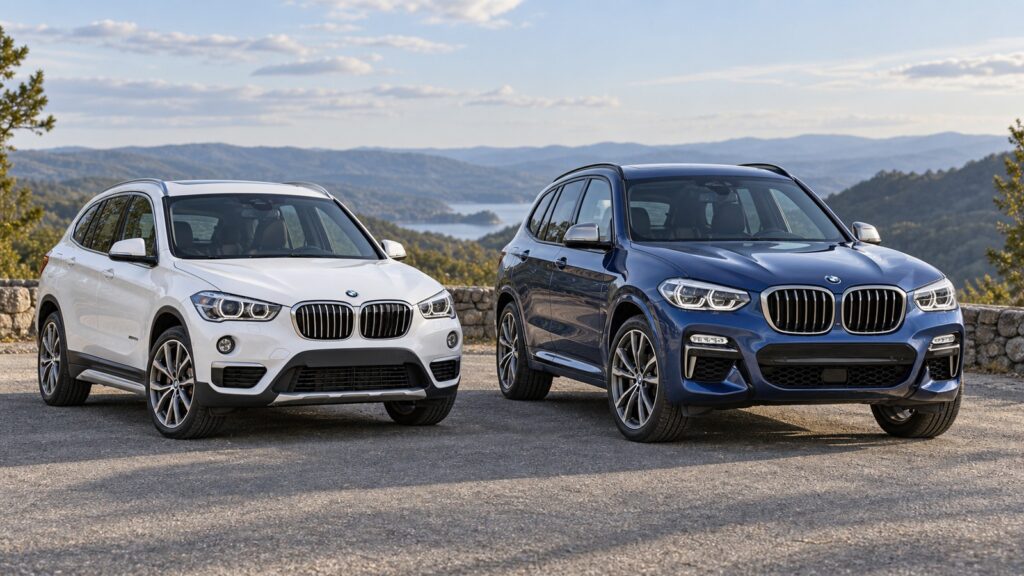
Shopping for a used luxury SUV usually starts with a budget and ends with a hard choice, and for a lot of buyers that choice lands squarely between the BMW X1 and the larger X3. Both wear the Bavarian badge, both drive well, and both can be found for reasonable money now that early examples have shed most of their new-car value. The question is whether the extra size and hardware of the X3 justify the extra cash.
- The second-gen X1 is a front-biased compact crossover, while the third-gen X3 rides on a rear-wheel-drive platform with stronger engine options.
- Both have known trouble spots, mostly around cooling systems and gaskets, so service history matters more than mileage alone.
- The X1 is the cheaper way into the brand, but the X3 holds value better and feels like a proper luxury vehicle.
Two SUVs Built With Very Different Priorities
The second-generation X1, the F48, ran from 2016 to 2022. BMW moved it onto a front-wheel-drive platform shared with Mini, which upset purists but paid off in packaging. Maximum cargo space grew to 58.7 cubic feet, turning what used to feel like a lifted hatchback into a genuinely useful compact crossover. A 2020 refresh brought a bigger grille, new LED headlights, and an 8.8-inch screen with Apple CarPlay.
The third-generation X3, the G01, arrived for 2018 and ran through 2024. It sits on the rear-biased CLAR architecture, with near 50:50 weight distribution, a 112.8-inch wheelbase, and multi-link suspension. The cabin uses better materials and quieter insulation, and cargo volume reaches 62.7 cubic feet. A 2022 update added a larger touchscreen running iDrive 7. In plain terms, the X1 dresses up an economy layout in premium clothing, while the X3 was engineered to fight the Porsche Macan and Mercedes-Benz GLC.
Power Delivery Is Where the Gap Shows
Every US-market X1 came with a 2.0-liter turbo four making 228 horsepower and 258 lb-ft, routed through an Aisin eight-speed automatic. It reaches 60 mph from a standstill in just over six seconds, and the xDrive28i is rated at 26 mpg combined by the EPA. It’s quick enough, but the transverse layout never feels as smooth as a longitudinal one.
The X3 gives you more to work with. The sDrive30i and xDrive30i use a longitudinal 2.0-liter turbo four with 248 hp, paired to the excellent ZF eight-speed. The real prize is the M40i and its B58 3.0-liter turbocharged inline-six, good for 355 hp early on and 382 hp from 2020, with a 0-60 time of 4.1 seconds. A plug-in hybrid xDrive30e was offered briefly with 288 combined horsepower. High-performance X3 M and X3 M Competition models joined in 2020.
Reliability Notes Every Buyer Should Check
Neither SUV is bulletproof. The X1’s B48 engine is solid, but the plastic oil filter housing tends to warp and crack over time, causing oil and coolant leaks. Watch for a failing electric water pump, worn front control arm bushings that clunk, and early xDrive transfer case actuator trouble that can cut all-wheel drive.
The X3 is a stout platform, yet the B58 is hard on its cooling system, so the main and auxiliary coolant pumps deserve attention. The active kidney grille shutters can stick closed and throw a check engine light, pre-facelift iDrive units glitch with CarPlay, and higher-mileage cars often seep oil from the filter housing and valve cover gaskets. A pre-purchase inspection and a full diagnostic scan are money well spent on either one.
What They Cost in 2026 and How to Decide
Depreciation has been kind to bargain hunters. Early 2016 to 2018 X1s often trade between $5,700 and $20,000, which puts them right up against mainstream used compacts. The updated 2020 and 2021 cars run roughly $10,000 to $30,000. If you’re cross-shopping that kind of money, the same instincts that guide a Toyota RAV4 vs Honda CR-V decision apply here, since value, upkeep, and resale matter as much as the badge.
The X3 asks more. A base 2018 or 2019 xDrive30i starts around $8,000, while sought-after early M40i examples land between $16,700 and $37,500, and a 2022 facelift car can push toward $50k. The payoff is a slower depreciation curve and stronger residuals, especially on the inline-six.
If your budget is tight and you mainly want the badge with everyday practicality, the X1 delivers. But if you can stretch, the X3 is the better machine in almost every measurable way, and its steadier resale softens the higher entry price. Buy the cleanest, best-documented example you can find, and let service records break the tie.




Leave a Reply