
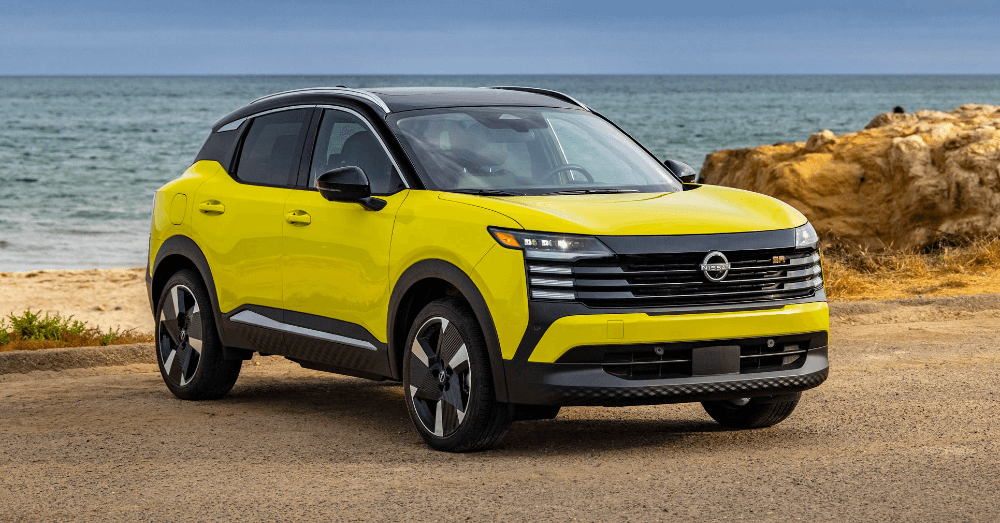
Nissan finally has a plug-in hybrid SUV for American buyers, and the price tag might raise a few eyebrows. The 2026 Nissan Rogue PHEV is now hitting dealerships with a base MSRP of $45,990, making it the brand’s first plug-in hybrid to reach the U.S. market. Built from a partnership with Mitsubishi, this electrified Rogue brings 248 horsepower, standard all-wheel drive, and up to 38 miles of electric-only range. But there’s a catch: it’s about $5,500 pricier than the Mitsubishi Outlander PHEV it’s based on.
- The two-trim Rogue PHEV lineup starts at $45,990 and offers 38-mile electric range, 248 horsepower, and AWD only.
- Nissan is relying on Mitsubishi and its Outlander PHEV, rebadging it as the 2026 Rogue PHEV.
- Nissan plans an all-new Rogue Hybrid e-POWER for late 2026, expanding its electrified options.
What You Get for the Money
While a 2025 Outlander PHEV starts at $40,445, the 2026 Nissan Rogue PHEV has a base MSRP of $45,990 for the SL trim. Opt for the nicer Platinum grade, and you’ll pay at least $49,990, excluding destination and handling at $1,495. That puts the out-the-door starting price at $47,485 including a required $1,495 delivery fee, with the Platinum capping out at $51,485.
For context, the gas engine 2026 Nissan Rogue will still be offered at $30,585 for the S trim. So the plug-in version commands a hefty premium, though you’re getting a lot more powertrain for that bump.
The setup includes dual electric motors, a 20 kWh lithium-ion battery pack, and a 2.4L gas engine, offering 38 miles of all-electric driving range. Combined, the 2026 Nissan Rogue PHEV puts out up to 420 miles of total driving range with an EPA fuel economy estimate of 64 MPGe. With the full force of the powertrain, you get a combined system output of 248 horsepower and 322 lb-ft of torque, which Nissan says will be enough to outpace a non-hybrid Rogue.
SL vs. Platinum Trim Features
Both trims of the Rogue PHEV get a 12.3-inch driver display and a nine-inch touchscreen infotainment setup with wireless Apple CarPlay. Android Auto users will still need to plug in both their crossovers and their smartphones. Both trims come with heated front seats, Nissan Safety Shield 360 driver aids, and four USB ports spread between the front and rear rows.
Step up to the Platinum and you’ll enjoy some nice upgrades. The Platinum grade includes a 10-inch head-up display, a Bose nine-speaker sound system, a power panoramic sunroof, heated rear seats, and more. It also features a pair of 120-volt, 1,500-watt power outlets, one in the trunk and one for the rear seats, that can operate small electrical appliances.
Safety is well covered on both trims. On top of 11 standard airbags, both trims come with Nissan’s Safety Shield 360 suite, which includes automatic emergency braking with pedestrian detection, high-beam assist, lane departure warning, rear cross-traffic alert, blind spot warning, and rear automatic emergency braking.
How It Compares and Why It’s Pricey
Nissan is charging $5,500 more for what amounts to a rebadged Mitsubishi Outlander PHEV. That pricing gap is tough to ignore, especially since the two vehicles share almost everything under the skin. While the non-hybrid Rogue is available as a front-wheel-drive vehicle, the Rogue PHEV is only offered with AWD.
One trade-off worth noting is charging speed. With a 3.5-kilowatt onboard charger, it’ll take 7.5 hours to replenish the battery with a Level 2 charger, and if you stick with a standard 120-volt wall outlet, you’re looking at 16 hours. The Rogue Plug-in Hybrid also lacks the Outlander plug-in hybrid’s CHAdeMO plug for DC fast charging.
And then there’s the warranty question. Nissan has far more dealers but only a 5-year powertrain warranty, while Mitsubishi has fewer dealers but 10 years of powertrain protection. That’s a real consideration if you plan to keep the vehicle long-term.
The Rogue Plug-in Hybrid also comes up a bit short compared to its closest competitor, the Toyota RAV4 PHEV, which has a 50-mile EV range.
Buyers should also be aware that the federal electric vehicle tax credit was eliminated as of October 1, 2025, with the signing of the “One Big Beautiful Bill Act.” The loss of the $7,500 federal tax credit has lowered the automaker’s expectations for sales of the Rogue PHEV to under 10,000 units in 2026.
A Bridge to Something Bigger
Don’t get too attached to this version of the Rogue PHEV. Nissan says an all-new 2027 Rogue Hybrid e-POWER will be launched toward the end of this year. Automotive News reported that Nissan originally intended to launch this second hybrid in the first half of 2027, but it’s now set to introduce it in October.
The Rogue Hybrid is a stopgap, one-year-only model, and Nissan says that the very next model year, 2027, will see the introduction of an all-new fourth-generation Rogue. That new model will use Nissan’s own e-Power system, which runs its gas engine as a generator only and does not move the wheels.
For shoppers who need an electrified Nissan SUV right now, 2026 Nissan Rogue PHEV pricing puts it in a crowded but interesting spot. It’s a capable vehicle with plenty of power and decent electric range for daily commuting. If you can wait, though, the 2027 model promises to be a purpose-built Nissan from the ground up, likely at a wider range of price points. Either way, Nissan is clearly getting serious about giving its bestselling SUV an electrified future.


Leave a Reply